 PlateProbe
The warning-label case
India does not yet have a front-of-pack warning label. What it has is a court case, two years old, in which the Supreme Court has been pushing the food regulator towards one. On 10 September 2026 the Court put 13 questions to FSSAI and the Union and asked for answers in ten days. Here is how the case got there, taken from the orders themselves.
Proposal — nothing on front-of-pack warning labels is in force
The case in dates
| Date | What happened |
|---|---|
| 15 May 2024 | Writ petition filed: 3S and Our Health Society v Union of India, WP(C) 437/2024. Registered 8 July 2024. |
| 22 and 29 Jul 2024 | First hearings; notice issued, returnable in four weeks. |
| 14 Nov 2024 | FSSAI added as a party; Home and Finance ministries dropped. |
| 18 Dec 2024 | Four weeks given for the government's reply. |
| 21 Feb 2025 | Hearing. |
| 9 Apr 2025 | Petition disposed of. FSSAI's expert committee told to report within three months; matter kept for compliance. |
| 10 Feb 2026 | Bench of Justices J.B. Pardiwala and K.V. Viswanathan: "not satisfied" with FSSAI's compliance affidavit of 30 Jan 2026; FSSAI to revert in four weeks. Later proceedings run as MA 1177/2025. |
| 13 Aug 2026 | Court says urgent headway on front-of-pack labelling is needed, points to international standards, and gives two weeks for a final decision. |
| 28 Aug 2026 | FSSAI affidavit: proposes a red hexagon warning, in two phases. |
| 10 Sep 2026 | Order 2026 INSC 988 (31 pages; Justices Pardiwala and K. Vinod Chandran). 13 questions listed; FSSAI to answer by affidavit within 10 days; next date 28 September 2026. |
| 28 Sep 2026 | Hearing held. Press reports say judgment was reserved. The written record was not available when this article was checked. |
What FSSAI put on the table
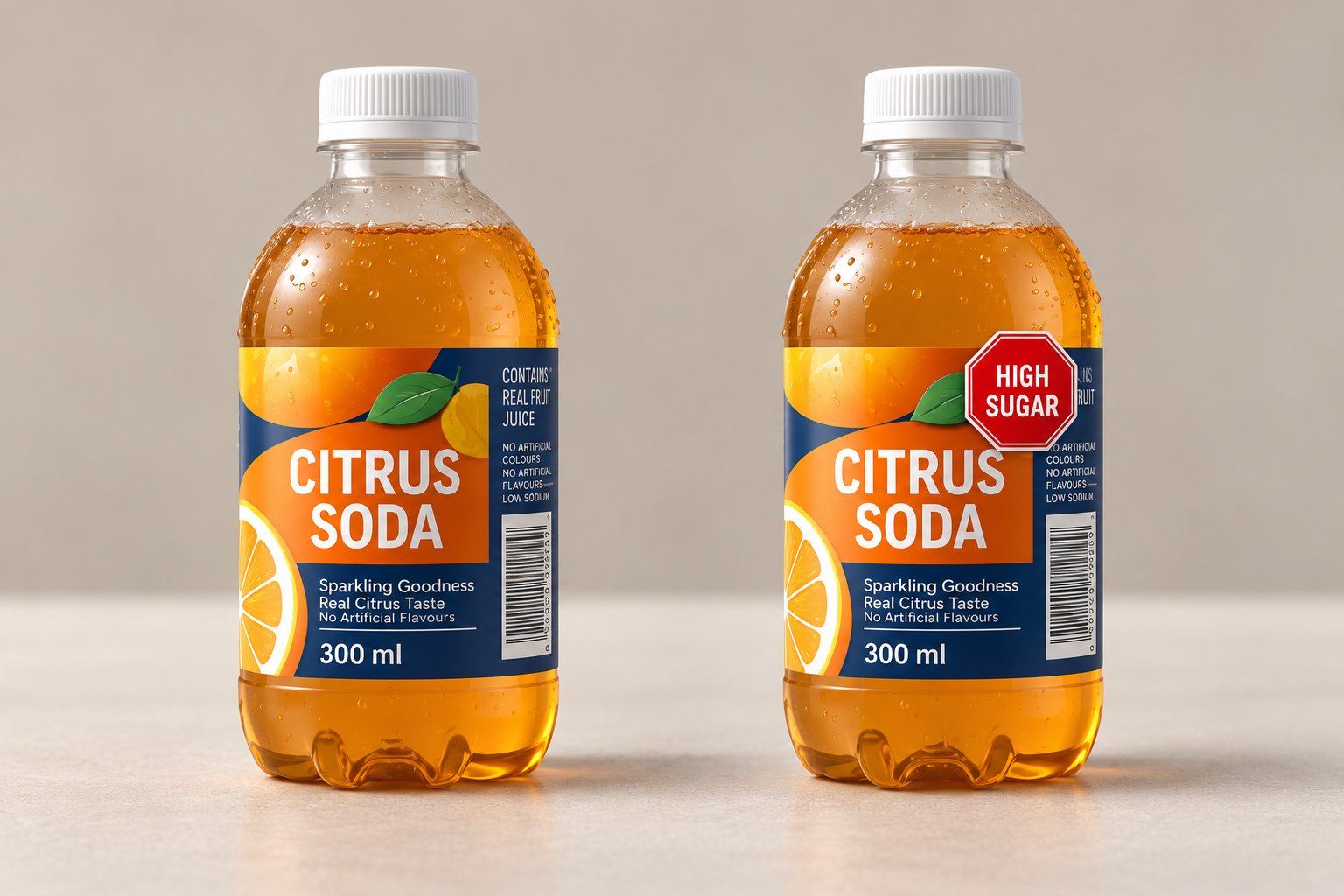
FSSAI's 28 August affidavit proposes a red hexagon on the front of the pack for foods high in nutrients of concern, with the words HIGH FAT, HIGH SUGAR, HIGH SALT or HIGHLY SWEETENED BEVERAGE as applicable. Thresholds would come from the ICMR-NIN Dietary Guidelines for Indians, 2024. The text would be one point larger than the back-of-pack nutrition table. Single-ingredient foods and foods that are by nature fat, sugar or salt (ghee, oil, salt, sugar, jaggery, honey) would be exempt. Phase I would cover products high in two or more of the three nutrients, plus specified sweetened beverages; Phase II would extend the label to products high in any one.
What the Court wants answered
The 13 questions at paragraph 53 of the 10 September order, in short:
| # | Question |
|---|---|
| i | A fixed timeline for the two phases. |
| ii | The basis for "two or more" nutrients in Phase I and "any one" in Phase II. |
| iii | How the Phase I sweetened beverages are identified, and their thresholds. |
| iv | Whether the label will distinguish ICMR-NIN food categories 2 and 3. |
| v | Whether it will distinguish group B (processed, no additives) from group C (processed with additives). |
| vi | Whether thresholds use total sugar and saturated fat, as agreed at the 29 Oct 2021 stakeholder meeting, and how trans fat is treated. |
| vii | Whether red should be revisited, given its association with non-veg marking. |
| viii | Hexagon dimensions, whether fixed or proportional to the pack, font size, and placement. |
| ix | How a words-only label serves consumers who cannot read it, with no pictorial per nutrient. |
| x | Why one combined hexagon rather than a separate hexagon per nutrient. |
| xi | How FSSAI will regulate a likely rise in preservatives and emulsifiers used to replace sugar, fat and salt. |
| xii | Whether there will be a voluntary period once the final rule is notified, and how long. |
| xiii | How the Union will teach label reading and nutrition literacy in schools. |
Two other points in the order matter for anyone reading labels. At paragraph 47 the Court said a per-serving, nutrient-reference-value display, which the food processors' association had asked for, gives useful data but "cannot raise a red signal"; a model that cautions on total content of the nutrients of concern "would be more appropriate". At paragraphs 48 to 50 the petitioner asked that the final rule be mandatory from the start; the Court noted that the 2022 draft Indian Nutrition Rating would have been voluntary for 48 months, and asked FSSAI to respond.
Where this leaves the shopper
For now, nothing changes on the shelf. The 2022 draft Indian Nutrition Rating (notified 13 September 2022, about 14,000 comments) was never finalised. The draft 2025 amendment that would have put sugar, salt and saturated fat in bold on the back panel (notified 17 February 2025) was deferred at the Food Authority's 49th meeting on 24 November 2025. The red hexagon is a proposal in an affidavit, which FSSAI itself says must still go through the regulation-making process. PlateProbe will update this item when the 28 September record or the next order is published.
Sources
Supreme Court of India, order dated 13 August 2026 (paras 15–22, as reproduced in the 10 September order).
Supreme Court orders of 22 Jul 2024, 29 Jul 2024, 14 Nov 2024, 18 Dec 2024, 21 Feb 2025, 9 Apr 2025 (case history as read from the orders).
Press reports of the 28 September 2026 hearing (judgment reserved) — not yet confirmed by a written order.