 PlateProbe
No added sugar and sugar free
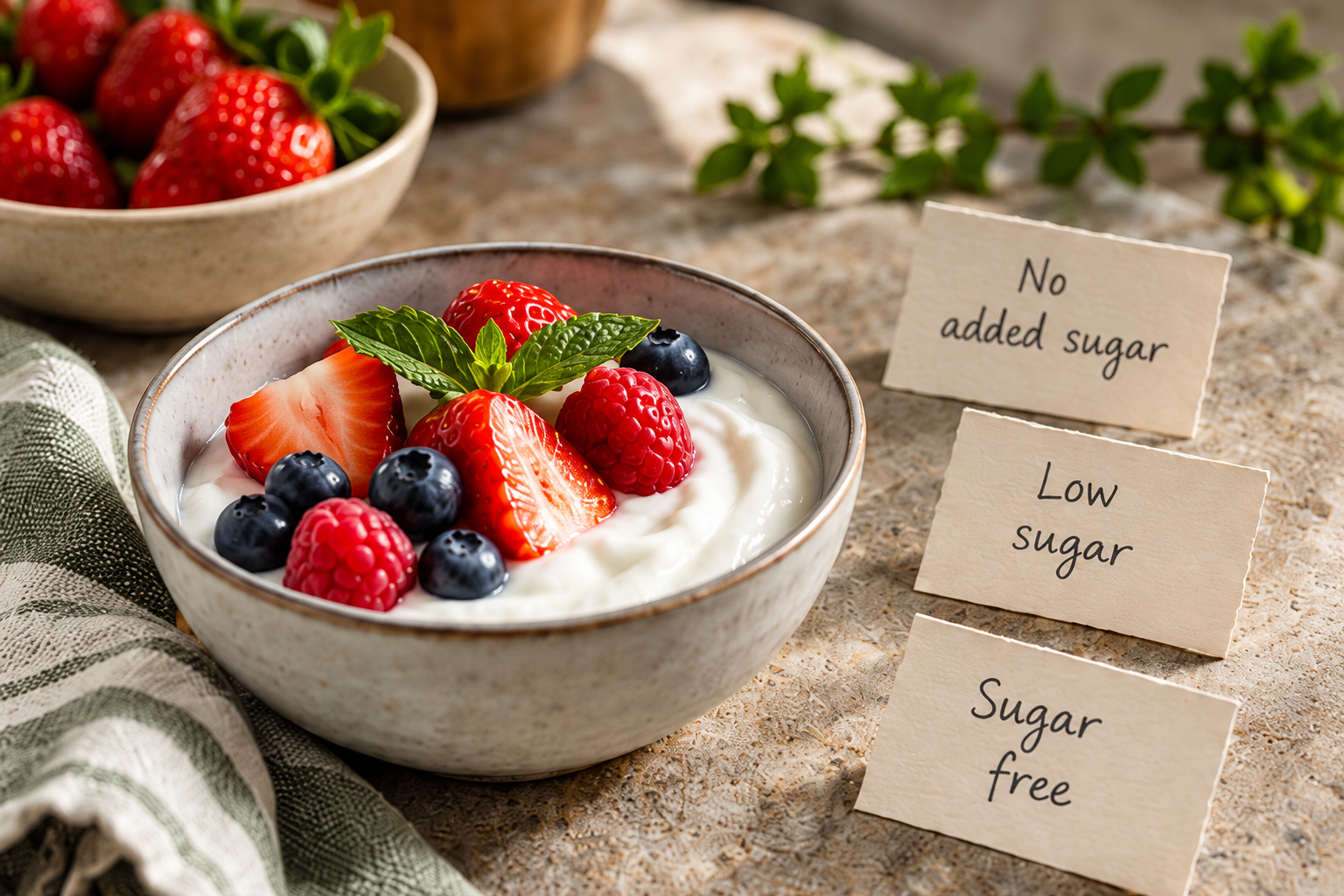
Three sugar claims sit on Indian packs: "no added sugar", "low sugar" and "sugar free". Each has its own test under the Food Safety and Standards (Advertising and Claims) Regulations, 2018. One is about the recipe. The other two are about the number on the nutrition panel.
In force — Advertising and Claims Regulations, 2018, reg 6(1) and Schedule I
| Claim | What it has to meet | Can the product still contain sugar? |
|---|---|---|
| No added sugar (a "non-addition" claim, reg 6(1)) | No sugars of any type added (sucrose, glucose, honey, molasses, corn syrup); no ingredient that contains sugars (jam, sweetened chocolate, sweetened fruit); no ingredient used in place of added sugar (concentrated fruit juice, dried fruit paste); and no process that raises sugar, such as enzymes breaking starch into sugar. | Yes. If sugars are naturally present, the pack must also say CONTAINS NATURALLY OCCURRING SUGARS. |
| Low sugar (Schedule I, item 10) | Not more than 5 g sugars per 100 g for solids, or 2.5 g per 100 ml for liquids. | Yes, up to those limits. |
| Sugar free (Schedule I, item 10) | Not more than 0.5 g sugars per 100 g or 100 ml. | A trace only. |
What "sugars" means here
The regulation defines sugars as all monosaccharides and disaccharides — glucose, fructose, sucrose, maltose, lactose. So a "sugar free" claim covers milk sugar and fruit sugar as well as table sugar. A "no added sugar" fruit juice can still carry 10 g of fruit sugar per 100 ml and be correctly labelled, provided the naturally-occurring-sugars line is there.
The words that count as the same claim
Schedule II lists the synonyms. "Zero", "no", "without" and "negligible" are treated as "free" and must meet the sugar-free limit. "Lite" and "light" are treated as "low" and must meet the low-sugar limit. A pack that says "zero sugar" has made the sugar-free claim whether or not it uses those exact words.
What the claim does not tell you
A sugar-free product can be sweet. The rule caps sugar; it says nothing about sweeteners. Check the ingredient list for them.
A no-added-sugar product can be high in sugar. The rule is about what was added, not what is there. Check the total sugars line on the nutrition panel.
Neither claim says anything about energy, fat or salt. A no-added-sugar biscuit is still a biscuit.
General principles apply on top: claims must be truthful, unambiguous and not misleading (reg 4(1)), and must not encourage excess consumption (reg 4(2)).